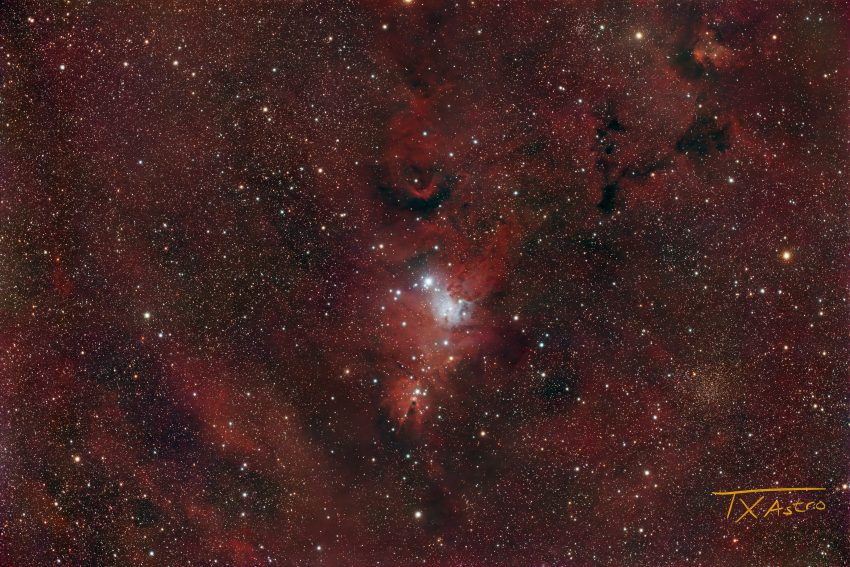
In November I collected some data on the Cone Nebula (NGC 2264) just to see what I can get from my heavily light polluted back yard. Well, the result surprised me once again. This wasn’t even collected with a super narrowband filter that only looks at very specific frequencies of light that come from ionized gasses. The filter I used was the IDAS LPS-P2, a broadband filter that only cuts out mercury and sodium. These kinds of lamps have fallen out of favor in recent years, replaced with LED lights that emit light all across the spectrum. While they do use significantly less power than mercury vapor and high pressure sodium lamps, they really suck for astrophotography.
Nonetheless, I soldier on and collect almost 7 1/2 hours of data over three days. Mostly because I was focusing on collecting narrowband data with my Optolong L-eNhance and L-Synergy filters to play with. The broadband LPS-P2 was an afterthought. I may need to change that philosophy given the results I’m getting.
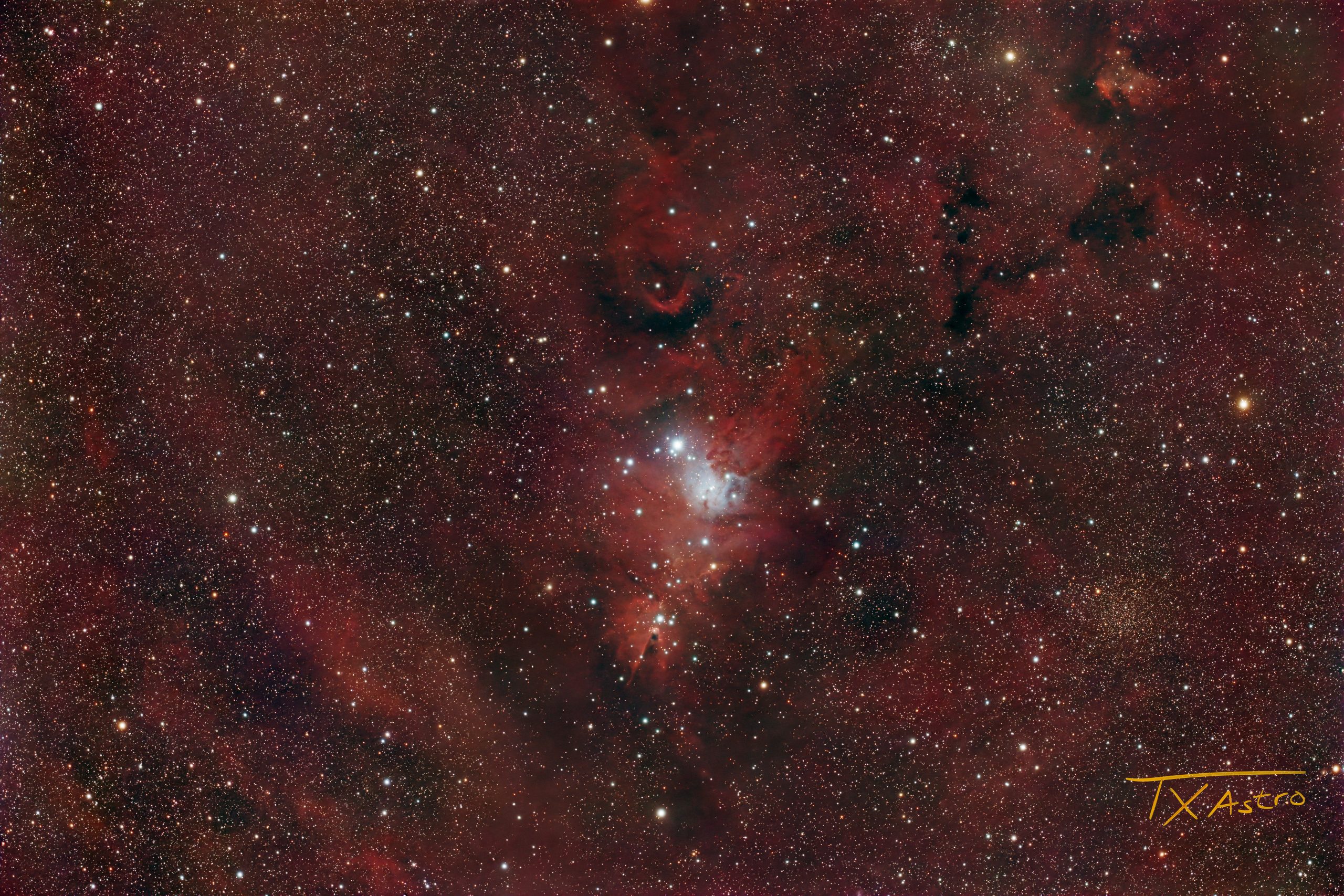
NGC 2264 is about 2,350 light years away plus or minute half a century. It’s located in the constellation Monoceros (the Unicorn) which is just east of Orion between Canis Major and Canis Minor. At the bottom center is the feature the nebula is named for, a dark conical structure that is the southern end of the star forming region bordered by the bright start at the top center of the image. Solar radiation from these hot, young stars energizes the gases around them. As that energy is released it is emitted as light in very specific frequencies that inform us as to the make up of these gasses. The vast majority of the gas we see is hydrogen, which emits a dark red light visible to humans, if we could detect color at such low intensity levels. While we can’t detect that color, cameras can. Particularly if you hold the shutter open for hours at a time, or add up a bunch of shorter images (79 frames of 5 minutes each in this case) to accumulate hours worth of photon collection.